ERNEST
ANG
Weekly Essay 1-3



Imagine this, you are scrolling through the apps on your new Android phone, and when you try to open the camera app to capture a very special moment, the phone hanged for the 3rd times today. Will you be angry and frustrated that you missed the special moment because the phone you are using is not up to your expectation? You start to regret getting that Android phone and missing your previous iPhone that never had this issue; it is reliable and easy to use. The emotion you are feeling or experiencing in this situation is known as user experience while using a smartphone, which is just part of our thousands of experiences in life, or referred as “micro-experience”. These experiences play a major role in determining why we like/dislike certain products or services, or even how much we like/dislike our job or relationships. Our respected guest speaker/classmate this week, Priyama Barua, who had a wonderful summer internship at Mad*Pow, a design agency that improves the experiences people have with technology, organizations and each other, assigned us with two Mad*Pow’s readings that discussed why companies need to adopt experience strategy and how to create customer journey map which is a tool used to interpret the overall story from an individual’s perspective in relations to an organization, service, product or brand. Jonathan Podolsky, the author for one of the readings, said that every product or service creates an experience for its user. So just how important is experience strategy in creating that experience, especially the positive one? And what can you do with customer journey map to enhance that positive experience?
To develop experience strategy, it is to put empathy and understanding of people at the core of the company’s operations. When a company employs a customer-centric approach, it is creating an Ecosystem of Touchpoints that could directly or indirectly impact or influence customers. Through understanding these touchpoints, company will be able to create a new, better and more positive customer-centric experience. According to Megan Grocki, in using a tool like customer journey map for an identified persona (a character that is created based on research findings), the company will be able to find a way to create that positive experience. Customer journey map is a set of qualitative analysis focuses on behavioral end results (how the behavior of the persona affected by certain experience), which is very different than marketing analysis approach that relied more on demographics information. It is also important to involve different level of stakeholders in creating the persona. This is no longer a generation which a company can easily sell a product/service without creating a positive customer experience. Businesses are interacting more and more with the users, through social media, websites, and smartphone; it is getting more complex and involved more touchpoints. There is no more one size fit all approach.
Being able to empathize which is mentioned repeatedly in both the readings, is a crucial element in designing a business solution. The IDEO human-centered design course I took last semester, also emphasized on using deep empathy and “what ifs” question to understand what people that you are designing a solution for truly want and need. Design is defined as planning, and being a designer is to plan function and meaning. What will truly separate us as design management students, from ordinary designer is that we have the tools to empathize with our customers/clients, utilizing all these information through design thinking and come out with a creative function and meaning that will bring delight to the customers/clients. To quote Jeanne de Bont, the Senior Design Consultant for Philips Design Innovation, “Design based on data brings us back to the essence of design and will leave out all unnecessary decoration.” Through the ability to empathized with people and developing experience strategy in a business operation, or maybe in everything that we do, we will then be able to create a positive experience not just for a business solution, but for everyone around us.
What is going through your mind when you are designing a poster? The choice of typeface that you will be using? The color that would convey your message to the audience? Does your design achieve a sense of harmony? Or everything that were mentioned and other considerations as well? That is what the two readings provided by Mr. Nathan Garland, a speech on typeface “On The Choice of Typeface” that was given in 1930 by Beatrice Warde and an article “Design and the Play Instinct” that was written by Paul Rand in 1965 talked about and are still being widely read. You would assume that in a generation today whereby almost everything is being digitalized, the content would be outdated and no longer applicable. But the information in these two readings written by these two graphic design’s giant in theirs generation, are indeed still relevant to today’s life. Being a non-graphic designer (model maker), I found these two readings really insightful especially in visual communication. Visual communication such as typography and graphic design is like a language in itself, it doesn’t just affect our readability, but also how we think, our emotions and our perspectives. When we read, our eyes move in a natural pattern known as the “scan path” in which we break the sentences into scans (saccades) and pauses (fixations). The pause comes after 7-9 letters to process what we have read and that is when our visual processing takes place. When we squint to process visual information, it actually affects our amygdala which controls our emotions. So the typeface, content and layout used in a design will impact how we process visual information. Hence, what should you consider when trying to convey a positive visual communication to your audiences?
In the first reading by Beatrice Warde, she discussed how a chosen typeface would affect the readers. She gave emphasis to two generalizations when choosing typeface, one of it is the typeface suitability, while the second one is whether the designer can take delight in his choice of typefaces. In this, I find that it’s very similar to model making in which the model maker has to find the suitable material that best represent the actual parts and how we use the material and make it as similar as possible to the actual parts, just in smaller scale. On the other hand, in the second reading by Paul Rand, he emphasized on involving playfulness in teachings with specific limitations and showed examples of different systems that encourages playfulness but with has its own rules that needed to be followed. One of the examples mentioned was the nine squares used for Chinese words that I found fascinating as that was the system I used to learn writing Chinese words when I was young. I never thought that it would be related to graphic design in achieving balanced symmetry. On the play instinct, Paul Rand in an interview described it as “the instinct for order, the need for rules that, if broken, spoil the game, create uncertainty and irresolution.” This is exactly what I’m learning through Professor White’s Graphic Design studio class. He set a rule for all his assignments and these set of rules allowed students to play with the form and meanings, but still within the constraint of his rules. Paul Rand also referred factors in game-playing are equally implied in successful problem-solving through playfulness and experimentation.
“Everything is design. Everything!”, a quote by Paul Rand, indicates how important design is in our life. The design mentioned here is not just on graphic design or for visual communication, but in our learning process and also using originality in solving problem as a whole. To emphasize on that, John Heskett said this, “Design is when designers design a design to produce a design.” So when you design, you are using design thinking to make this world a better place, to create a positive experience. I may not be a graphic designer or a designer that is as significant as Beatrice Warde or Paul Rand was, but I sure hope that everything that I am learning now in the design management program, I will be able to apply them as a designer in solving business problems within the limitations of the triple bottom line which are people, planet and profit. So as a design management student, would you be doing the same too? It is your choice.
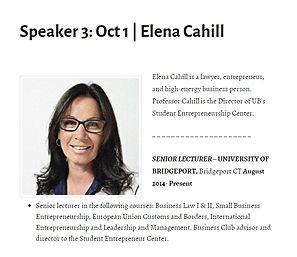
Have you ever had a professor or teacher that assign you with an assignment without giving you any guidelines and you have no idea where to start? Or do you remember a time when a waiter ask what would you like to drink and if the beverage list seems to have unlimited options, you can’t seem to decide what to order? Both of these situations are applicable to innovating process as well. When you are overwhelmed with options in an innovating process, you will probably struggle to coordinate your innovative activities. Our speaker this week, Professor Elena Cahill assigned us with the reading “The Simple Rules of Disciplined Innovation” by management guru, Donald Sull that was published in the McKinsey Quarterly (May 2015), explaining to the readers that “constraints aren’t the enemy of creativity – they make it more effective.” So how true is that? Growing up, everyone around me always refer to the phrase “think outside the box” when they try to encourage people to think innovatively. Donald Sull, on the other hand, suggested otherwise. He described the innovative process as drawing the right box and innovates within it. He called this disciplined approach, simple rules.
Simple rules as suggested by the author, is most commonly applied to sustaining kind of innovation as a guidelines, and not disruptive innovation. It is to add discipline to the innovative process that will create value, such as incremental products improvements and advances in existing business models which is important for many established companies. Simple rules as described, has to be simple and few in number, apply to a well-defined activity or decision (select innovations and how to pursue innovations) and tailored to the unique culture and strategy of the organization involved. Through this approach, one can also collectively create more value through innovation by interacting with members of a community or ecosystem, constrained by the simple rules set that aligned with the purpose of innovation. Coincidentally, in the article “Design and the Play Instinct” by Paul Rand that we read last week, also suggested that having formal limitations in solving specific problem invites creativity, such as in game-playing. In conjunction to that, I find that the simple rules disciplined approach is very similar to design thinking process, in which both are human-centered, collaborative, optimistic as well as experimental.
As stated in the reading, there are no tool that can guarantee successful innovation. However, in another McKinsey Quarterly article titled “The Eight Essentials of Innovation Performance”, the authors for that article concluded that committed leadership is the greatest predictor of innovation success. I strongly believe that everything that is being taught in the Design Management program is to prepare us, the students to be that type of leader, a committed leader that is capable of setting simple rules and applying design thinking in encouraging innovative process, and creating value for both the companies and the end-users. The eight essentials mentioned in that article: aspire, choose, discover, evolve, accelerate, scale, extend and mobilize are also important attributes that we should always pay attention to. So, next time when you are involve in an innovation process which most probably be the Collaborative Design Studio class, do remember that you can use simple rules within the group to balance concrete guidance with the freedom to exercise the group’s creativity in solving the client’s business problems that will bring delight to them.